Safety is non-negotiable when installing mechanical lifting equipment in a private residence. Understanding safety mechanics and drive choices empowers home builders, architects, and owners to make informed decisions.
This article outlines the engineering principles behind modern residential lifts.
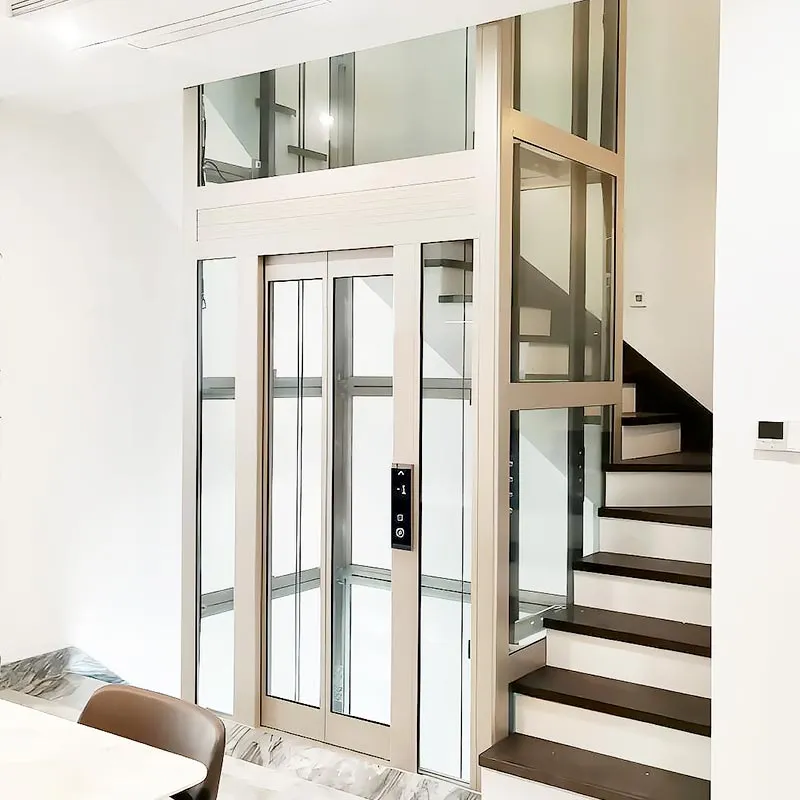
Home Lift
A certified home elevator must incorporate redundant mechanical and electrical safety systems to protect passengers under all conditions.
| No. | Redundant Safety Framework Component |
| 1 | Mechanical Safety Gear & Overspeed Governor |
| 2 | ARD (Automatic Rescue Device – Battery Backup) |
| 3 | Full-Height Infrared Door Light Curtains |
| 4 | Emergency Manual Lowering Valve / Brake Release |
| 5 | Buffer Springs at Shaft Bottom |
Automatic Rescue Device (ARD): In the event of a municipal power grid failure, the ARD automatically switches to battery power, bringing the elevator car to the nearest floor and opening the doors automatically.
Overspeed Governor & Safety Gear: If downward speed exceeds safe thresholds (e.g., 0.4 m/s), a mechanical governor instantly clamps the car onto the guide rails, stopping it independently of electrical power.
Infrared Light Curtains: Creates an invisible screen across the entrance. If an object or pet crosses the threshold, the doors immediately re-open to prevent pinching.
How it works: Uses a permanent magnet synchronous motor (PMSM) and steel wire ropes or composite belts.
Pros: Ultra-quiet operation (<45 dB), low energy consumption, smooth acceleration.
Best for: Multi-story homes requiring frequent daily trips and long service life.
How it works: Uses a hydraulic pump to force fluid into a ram, raising the car.
Pros: High load capacity, highly reliable, easy manual emergency lowering.
Best for: Heavier loads or homes with limited headroom at the top floor.
When reviewing manufacturer credentials, look for these international benchmarks:
CE Marking / EN81-41 Standard: European safety standard specifically designed for vertical platform lifts and residential elevators.
ISO 9001 Quality Control: Guarantees precision fabrication of structural steel, glass panels, and mechanical components.
I’m Laura, the author of this article and the CEO & Marketing Director of WEMET. With over 15 years of experience in the intelligent lifting industry, I’m dedicated to helping clients find the right access solutions for their needs. If you have any questions, feel free to contact me at any time.

 AWP
AWP
 Industrial Lift
 Home Elevator
 Intelligent Storage