Unlike mobile alternatives, a fixed scissor lift is built directly into a factory’s infrastructure—often embedded within a concrete pit or anchored permanently to the production floor. Because it becomes a permanent part of your material handling workflow, vague procurement requests lead to costly structural misalignments. This guide details the critical engineering parameters needed to build an airtight RFQ for specialized manufacturers.
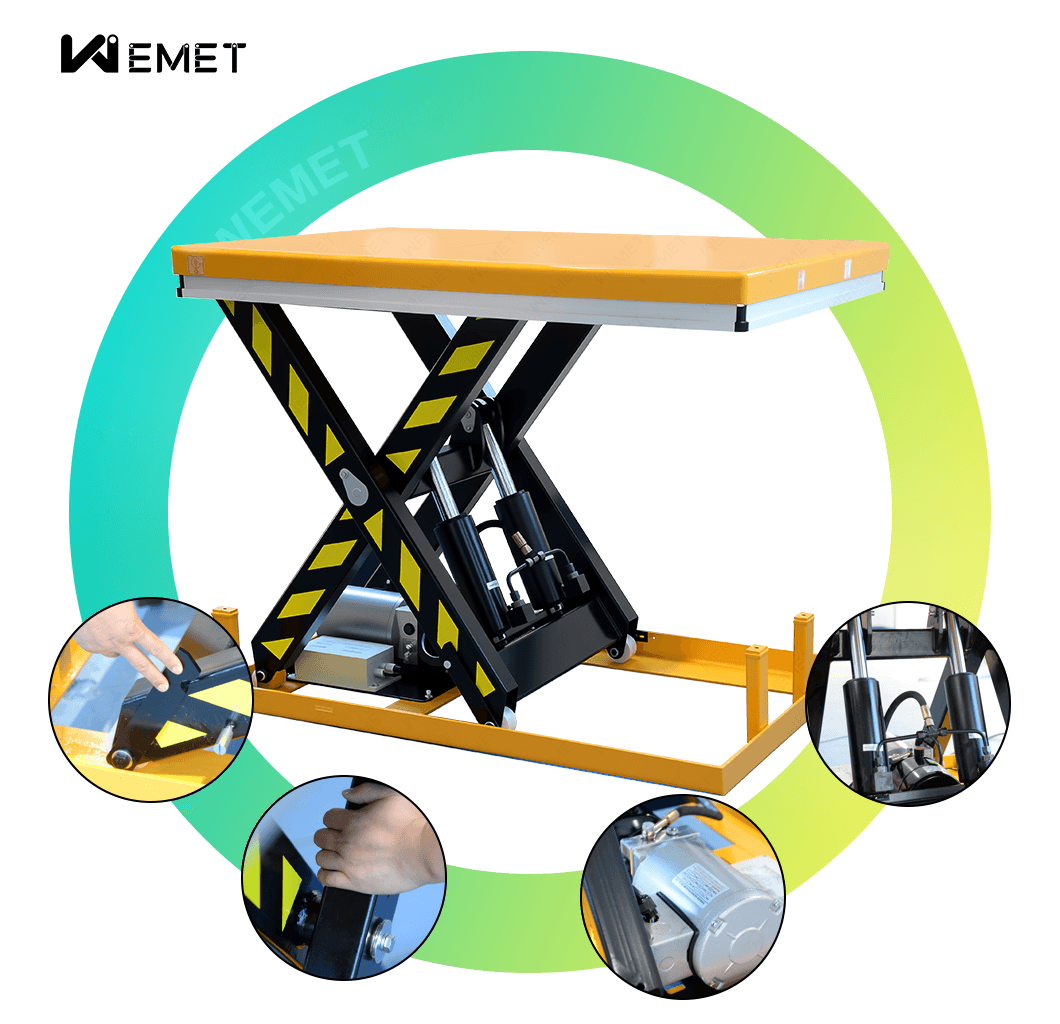
Fixed Scissor Lif
When requesting quotes from global manufacturers, providing data in a clear, structured table drastically speeds up technical review and ensures accurate pricing. Fill out the following technical matrix for your engineering submission:
| Engineering Parameter | Your Project Specification / Required Data |
| Rated Load Capacity | (e.g., 2,500 kg / 5,000 kg) |
| Maximum Lift Height (Stroke) | (e.g., 1,800 mm) |
| Closed / Lowered Height Profile | (e.g., 350 mm) |
| Platform Surface Dimensions | Length (mm) x Width (mm) |
| Required Pit Depth (If Applicable) | (e.g., 360 mm) |
| Power Supply Grid Compatibility | Voltage (V) / Frequency (Hz) / Phase |
| Surface Finish & Anti-Corrosion | (Industrial Powder / Hot-Dip Galvanized) |
Lifting Architecture: Single, double, or tandem fixed scissor arm configurations designed for minimal center deflection under non-uniform edge loading.
Pit Installation Specifications: Exact floor recess depth tracking to the millimetre, integrated with peripheral drainage and embedded steel edge protectors.
Control & Integration: Safe 24V DC control pendants, foot switches, or standard digital relay outputs (Modbus/PLC) for seamless conveyor line synchronization.
The longevity of a fixed scissor lift depends entirely on how it handles off-center loads. When a heavy forklift drives over the edge of a lowered platform, the structure experiences massive dynamic torsional stress.
| Component / Feature | Standard Utility Grade | Heavy Industrial / Fixed Line Grade |
| Material Build | Standard Hollow Sections | Heavy-Duty Solid Q345 Steel Plate |
| Edge Load Rating | 30% of total capacity | Up to 100% axled edge capacity |
| Hydraulic Seals | Standard Nitrile O-Rings | Premium Polyurethane Double-Lip Seals |
To mitigate platform tipping, top-tier engineering firms utilize advanced CNC boring for arm pivot pins, maintaining tolerances under 0.05 mm to guarantee perfectly balanced hydraulic pressure distribution across the cylinders.
Before finalizing a fixed equipment purchase, verify that the supplier’s engineering file includes the following quality assurances:
Regulatory Safety: Full certification under EN 1570-1 (Safety requirements for lifting tables) or regional equivalents.
Emergency Measures: Built-in mechanical anti-fall locks, maintenance safety props, and perimeter safety trip bars to stop down-travel upon contact.
Stress Analysis: Verifiable Finite Element Method (FEM) analysis reports proving structural stability under 125% structural stress testing.
I’m Laura, the author of this article and the CEO & Marketing Director of WEMET. With over 15 years of experience in the intelligent lifting industry, I’m dedicated to helping clients find the right access solutions for their needs. If you have any questions, feel free to contact me at any time.

 AWP
 Industrial Lift
 Home Elevator
 Intelligent Storage